
Categories
Artificial Intelligence Computer Science

Retrieval Augmented Generation (RAG)

There is a trending term that is floating around in the Artificial Intelligence (AI) field, i.e., “RAG”. So, to satisfy the curiosity, let’s get to know what RAG is. Before that, let us have a brief idea of Generative AI.

Generative AI is an Artificial Intelligence system capable of creating new and original content in the form of text, code, images, audio, and video by learning patterns from large datasets or Large Language Models (LLMs) and analyzing and applying them to produce contextually relevant outputs.

How does it work?

Training: Deep Learning models are trained on large datasets to learn patterns and relationships.

Tuning: Fine-tuning the AI model with LoRA/QLoRA ranking techniques or Reinforcement Learning from Human Feedback (RLHF).

Generation: The AI responds to user queries and prompts by generating text, images, audio, or video based on up-to-date, factual data.

The generative models use “Transformers” to predict the next tokens based on context and produce logical text.

Below is an example of a code snippet that uses transformers to generate the response to a user query:

transformer.py
Python
from transformers import pipeline
# Load a pre-trained text generation pipeline
generator = pipeline("text-generation", model="gpt5")
# Generate text based on a prompt
prompt = "In the future, AI will"
result = generator(prompt, max_length=50, num_return_sequences=1)
print(result[0]['generated_text'])
Types of models:

Transformers: Text/code generation based on LLMs and uses self-attention for context capture.

Diffusion models: Generate high-quality images/audio by iterative denoising.

GANs and VAEs: Image synthesis, style transfer, data augmentation

Encoder-Decoder: Translation, Summarization, and Multimodal tasks.

Generative AI Applications:

Text-generation (chatbots, summarization, and code generation), Image-generation (Art, medical images), Audio-generation (voice synthesis, music creation), Video-generation (animation, simulation).

Limitations of Generative AI
  • Generative AI models are prone to hallucinations and thus are less accurate.
  • Generative AI is not real-time. It is limited to its training cut-off, i.e., it does not access updated information until it is retrained.
  • It lacks access to the internal and proprietary data (For example, company reports, release notes, etc.).
  • It works with Large models and datasets. So it is resource-intensive with respect to compute and storage. So, fine-tuning becomes difficult.

These limitations make the urge to think about an improved methodology and architecture. Here is where “RAG” comes into the picture.

Retrieval Augmented Generation (RAG) is a technique that adds relevant context to AI, resulting in improved and accurate responses.

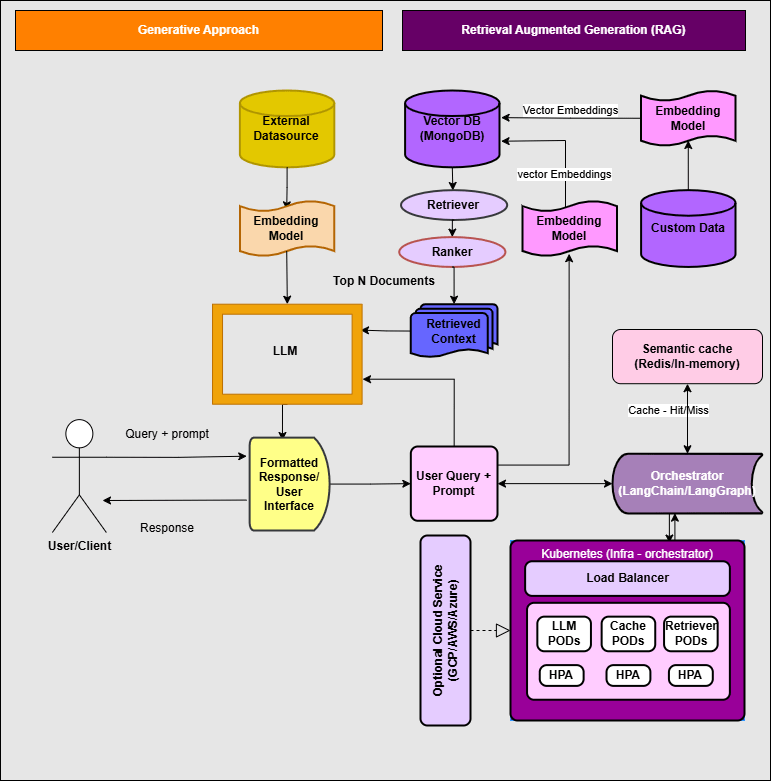
RAG Architecture
Generative AI vs RAG Comparison:
AspectGenAIRAG
AccuracyProne to hallucinationsGrounded in retrieved sources
Knowledge FreshnessStatic, limited to training cutoffDynamic, can access real-time data
Domain AdaptabilityWeak with proprietary/internal dataStrong, integrates custom datasets
Resource NeedsHigh (training/fine-tuning)Lower (retrieval pipeline setup)
CreativityStrong (novel, diverse outputs)Moderate (depends on retrieved context)
TraceabilityLimited (no source attribution)High (answers linked to documents)

Knowledge Index – An external knowledge source is a foundation for a RAG system. The knowledge source can be any domain-specific custom dataset, documents, databases, APIs, or structured tables.

Document Loader – The document loader standardizes and normalizes the documents from knowledge index data sources such as local files, web pages, cloud storage, or databases. The text splitter extracts the text, splits the text into chunks, and enriches it with metadata for the embedding phase.

Embedding – The text chunks are converted into numerical vectors using embedding models and capturing semantic meaning.

Vector Store – The embeddings are stored in a vector database or vector store. The vector database enables fast similarity searches and retrieves relevant context based on the user’s query.

Retriever – The query encoder converts the user input into a vector representation. The retriever then searches the vector database using semantic similarity or other search techniques to fetch the most relevant chunks of information.

Ranker – The ranker will carry out duplication, relevance ranking, and context enrichment on the vector embeddings. The retrieved and ranked chunks are then combined with the user query to generate a better and more accurate response.

Generator – The generator is the large language model (LLM) that synthesizes the retrieved context and user query to produce a grounded response. The modern RAG systems may use generators for query rewriting, self-evaluation, and corrective re-retrieval.

Output response – Output response is a formatted final response that is sent to the user.

Updator (Optional) – Some RAG systems use an updator to refresh and re-embed the data to ensure the knowledge base remains current and updated. The updator can be equipped with an agentic framework for automated refreshment of knowledge base.

RAG stands for Retrieval Augmented Generation.

  • Retrieval – Find relevant information.
  • Augmentation – Add data to AI’s knowledge.
  • Generation – Generate a better and more accurate response.

The purpose of RAG is to add relevant context to AI and generate an accurate response.

Categories
Coding Computer Science Python

Solving Problem: Sum of Multiples

The sum of multiples of k below n is:

Formula:

Sk=kβ‹…m(m+1)2

where m=⌊nβˆ’1kβŒ‹.

Find the sum of multiples of 3 or 5 below N.

For example:

If we list all the natural numbers below that are multiples ofΒ Β 3 orΒ 5, we getΒ 3, 5, 6, and 9. The sum of these multiples isΒ 23.

Input Format

The first line containsΒ Β T, which denotes the number of test cases. This is followed by T lines, each containing an integer,Β N.

Constraints

  • 1 <= T <= 10^5
  • 1 <= N <= 10^9

Output Format

For each test case, print an integer denoting the sum of all the multiples ofΒ 3Β orΒ 5Β belowΒ N.

Sample Input 0

2
10
100

Sample Output 0

23
2318

Explanation 0

ForΒ if we list all the natural numbers belowΒ 10Β that are multiples ofΒ Β 3 orΒ 5, we getΒ 3, 5, 6,Β andΒ 9. The sum of these multiples isΒ 23.

Similarly, forΒ N=100, we getΒ 2318.

sum_of_multiples.py
Python
#!/bin/python3
import sys
t = int(input().strip())
if 1 <= t <= pow(10,5):
def sum_of_multiples(k, limit):
m = (limit - 1) // k
return k * m * (m+1) // 2
for a0 in range(t):
n = int(input().strip())
s3 = sum_of_multiples(3, n)
s5 = sum_of_multiples(5, n)
s15 = sum_of_multiples(15, n)
total = s3 + s5 - s15
print(total)

Input (stdin)

  • 2
  • 10
  • 100

Your Output (stdout)

  • 23
  • 2318

Expected Output

  • 23
  • 2318
sum_of_multiples1.py
Python
import sys
t = int(input().strip())
if 1 <= t <= pow(10,5):
for a0 in range(t):
n = int(input().strip())
total = 0
# print("n = ", n)
if 1 <= n <= pow(10,9):
if n == 1:
total = n
li = [i for i in range(1, n) if (i%3 == 0 or i%5 == 0)]
total = sum(li)
print(total)

The above code has O(n) complexity; however, it fails under memory constraints. When used with the arithmetic formula, the time complexity becomes O(1).

Contests | HackerRank

Categories
Computer Science

Bit Manipulation Basics

(Python)

Let’s have a quick review of Bit Manipulation techniques in Python.

OperatorDescriptionExample
&Bitwise ANDa & b
`Bitwise ORa ` b
^Bitwise XORa ^ b
~Bitwise NOT~a
<<Left Shifta << n
>>Right Shifta >> n
Python
# Bit manipulation demo in Python
def bit_operations(a: int, b: int):
"""Perform common bitwise operations on two integers."""
try:
# Ensure inputs are integers
if not isinstance(a, int) or not isinstance(b, int):
raise ValueError("Both inputs must be integers.")
print(f"a = {a} ({bin(a)})")
print(f"b = {b} ({bin(b)})\n")
# AND
print(f"a & b = {a & b} ({bin(a & b)})")
# OR
print(f"a | b = {a | b} ({bin(a | b)})")
# XOR
print(f"a ^ b = {a ^ b} ({bin(a ^ b)})")
# NOT
print(f"~a = {~a} ({bin(~a)})")
print(f"~b = {~b} ({bin(~b)})")
# Left shift
print(f"a << 2 = {a << 2} ({bin(a << 2)})")
# Right shift
print(f"a >> 2 = {a >> 2} ({bin(a >> 2)})")
except ValueError as e:
print(f"Error: {e}")
# Example usage
if __name__ == "__main__":
bit_operations(7, 3) # 7 = 0b111, 3 = 0b011

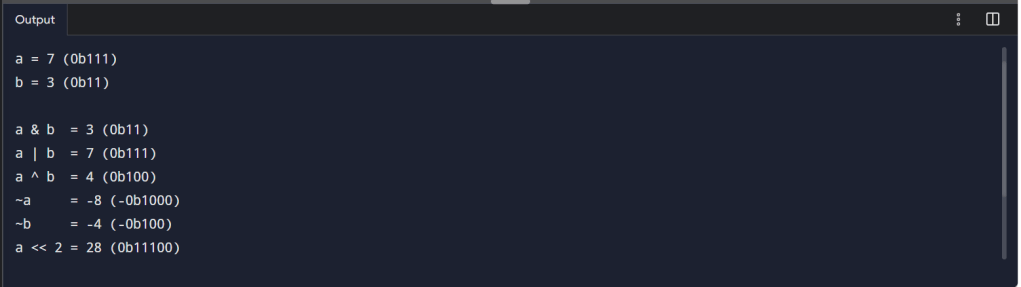
a = 7 (0b111)
b = 3 (0b11)

a & b = 3 (0b11)
a | b = 7 (0b111)
a ^ b = 4 (0b100)
~a = -8 (-0b1000)
~b = -4 (-0b100)
a << 2 = 28 (0b11100)

Python
# Check if the k-th bit is set (0-indexed from right)
def is_kth_bit_set(n, k):
return (n & (1 << k)) != 0
# Set the k-th bit
def set_kth_bit(n, k):
return n | (1 << k)
# Clear the k-th bit
def clear_kth_bit(n, k):
return n & ~(1 << k)
# Toggle the k-th bit
def toggle_kth_bit(n, k):
return n ^ (1 << k)
# Count set bits (Brian Kernighan’s Algorithm)
def count_set_bits(n):
count = 0
while n:
n &= (n - 1)
count += 1
return count
n = 13
k = 2
print(f"n = {n} Binary n: ", bin(n))
print(f"k = {k} Binary k: ", bin(k))
print("Is 'k'th bit set? ", is_kth_bit_set(n,k))
print("n after setting 'k'th bit: ", set_kth_bit(n,k), f"Binary n = ({bin(n)})")
print("n after clear 'k'th bit: ", clear_kth_bit(n,k), f"Binary n = ({bin(n)})")
print("n after toggle 'k'th bit: ", toggle_kth_bit(n,k), f"Binary n = ({bin(n)})")
print("Set bits in n: ", count_set_bits(n))

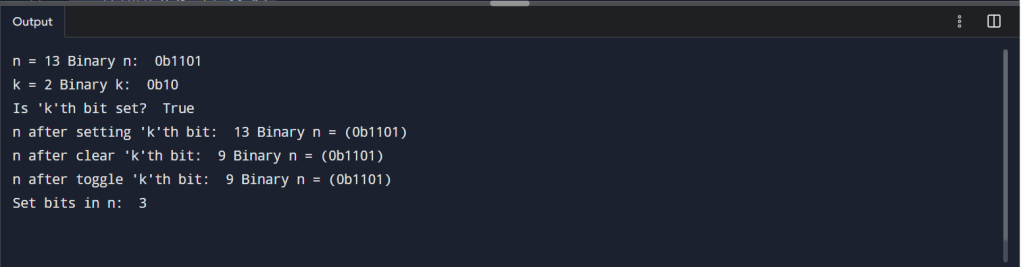
Output:

n = 13 Binary n: 0b1101
k = 2 Binary k: 0b10
Is ‘k’th bit set? True
n after setting ‘k’th bit: 13 Binary n = (0b1101)
n after clear ‘k’th bit: 9 Binary n = (0b1101)
n after toggle ‘k’th bit: 9 Binary n = (0b1101)
Set bits in n: 3

Categories
Computer Science

Types of AI

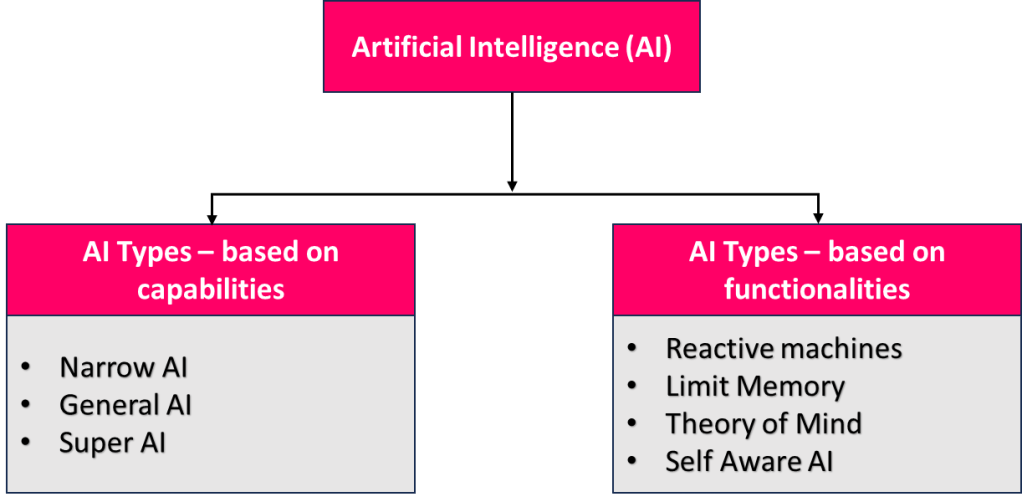
Artificial Intelligence (AI) is a trending technology around the world. Let’s understand its types.

Artificial Intelligence (AI) is the capability of a computational system to pursue human intelligence, like learning, reasoning, perception, problem solving, and decision making.

Narrow AI (Weak AI): Narrow AI is designed and trained on a specific task or a narrow range of tasks. They perform their designated tasks but cannot generalize tasks. For example, Voice Assistants (Alexa, Siri), Face Recognition Systems, Recommendation systems like Netflix, etc.

General AI (General AI): General AI refers to machines that can perform any intellectual task like humans, with the ability to learn and adapt across tasks, though it remains theoretical and still not fully developed. For example, Autonomous Robots, AI diagnostics, Autonomous driving, cooking, and Coding.

Super AI (Super Intelligent AI): Super AI is a theoretical concept where AI surpasses human intelligence. They can make decisions of their own and solve problems on their own. For example, outperforms humans in all fields, including creative and Decision-making AI, raises ethical concerns, and controls.

This classification is based on how AI handles data, memory, and decision-making in different scenarios.

1. Reactive Machines

Reactive machines purely operate based on the present data and do not store any previous experiences or learn from past actions. These systems respond to specific inputs with fixed outputs and are unable to adapt. Examples: AI Chess Bots, Pattern Recognition AI.

2. Limited Memory in AI

Limited Memory AI practices past data to make better decisions and predictions, but lacks long-term memory, and most modern AI applications belong to this type. Examples: Self-driving cars, Chatbots.

3. Theory of Mind

Theory of Mind AI tries to understand human emotions, beliefs, and intentions, enabling more sophisticated and responsive interactions. Examples: Human-Robot interface detecting emotions, Collaborative Robots in Healthcare.

4. Self-Awareness AI

Self-Aware AI is an advanced AI that holds consciousness, enabling it to understand emotions and have self-awareness like humans. Examples: Fully autonomous moral decision-making systems, environment-sensing robots.

This classification is generally based on what the AI can do in real-world systems.

1. Generative AI (Gen AI)

Gen AIΒ creates new content like text, images, audio, or code by learning patterns from data. It uses deep learning models like transformers. Example: Chatbots generating answers, AI image generators, and code generation tools.

2. Agentic AI

Agentic AIΒ acts autonomously to achieve goals, making choices and executing tasks without constant human input. It can plan, execute, and adapt. Example: AI that books tickets after comparing prices, Task automation agents, and multi-step problem-solving systems.

3. Natural Language Processing (NLP)

NLPΒ allows machines to understand, interpret, and communicate using human language. Works with text and speech. Example: Chatbots, Language translation, Sentiment analysis.

4. Computer Vision

Computer VisionΒ allows machines to analyse, recognize, and interpret images and videos. It detects objects, faces, and patterns from visuals. Example: Face recognition, medical image analysis, and self-driving car vision systems.

Categories
Computer Science

Object Oriented Programming – PolymorphismΒ 

PolymorphismΒ meansΒ “many forms”.
In OOP, it allows theΒ same method nameΒ (or operator) to behave differently depending on the object or data type it is acting upon.

It helps in:

  • Code reusability
  • Flexibility
  • Maintainability

Python mainly supportsΒ runtime polymorphismΒ (method overriding) andΒ compile-time-like polymorphismΒ (method overloading via default arguments orΒ *args).

A single function can work with different types of objects.

Python
# Example: Same function name, different object types
class Dog:
def speak(self):
return "Woof!"
class Cat:
def speak(self):
return "Meow!"
def animal_sound(animal):
print(animal.speak())
# Using polymorphism
dog = Dog()
cat = Cat()
animal_sound(dog) # Woof!
animal_sound(cat) # Meow!

Here,Β animal_sound()Β works withΒ any objectΒ that has aΒ .speak()Β method β€” this isΒ duck typingΒ in Python.

Child classes canΒ overrideΒ methods from the parent class.

Python
class Bird:
def fly(self):
return "Some birds can fly."
class Sparrow(Bird):
def fly(self):
return "Sparrow flies high."
class Penguin(Bird):
def fly(self):
return "Penguins can't fly."
# Runtime polymorphism
for bird in [Sparrow(), Penguin()]:
print(bird.fly())

Output:

Sparrow flies high.
Penguins can't fly.

Many built-in functions in Python are polymorphic.

Python
print(len("Hello")) # Works on string β†’ 5
print(len([1, 2, 3])) # Works on list β†’ 3

Operators likeΒ +,Β *, etc., behave differently for different data types.

print(5 + 10) # Integer addition β†’ 15
print("Hi " + "Py") # String concatenation β†’ Hi Py

You can define custom behavior usingΒ magic methods:

Python
class Book:
def __init__(self, pages):
self.pages = pages
def __add__(self, other):
return self.pages + other.pages
b1 = Book(100)
b2 = Book(200)
print(b1 + b2) # 300

Sure! Let’s break downΒ polymorphism in PythonΒ in the context ofΒ Object-Oriented Programming (OOP).

  • PolymorphismΒ lets the same interface work for different data types or classes.
  • In Python, it’s often achieved throughΒ method overriding,Β duck typing, andΒ operator overloading.
  • It improvesΒ code flexibilityΒ andΒ reduces duplication.

If you want, I can prepare aΒ single Python programΒ that demonstratesΒ all types of polymorphismΒ in one place for easy learning.
Do you want me to create that?

Categories
Computer Science

Object Oriented Programming – Inheritance

Inheritance is a fundamental concept in object-oriented programming (OOP) that allows a class to inherit attributes and methods from another class. This promotes code reusability and establishes a hierarchical relationship between classes.

In Python, inheritance is implemented by defining a new class that derives from an existing class. The derived class (child class) inherits the attributes and methods of the base class (parent class). Here is a basic example:

Python
# Parent class
class Person:
def __init__(self, name, id):
self.name = name
self.id = id
def display(self):
print(self.name, self.id)
# Child class
class Employee(Person):
def print_emp(self):
print("Employee class called")
# Creating an object of the child class
emp = Employee("John", 101)
emp.display() # Calling parent class method
emp.print_emp() # Calling child class method

In this example, theΒ EmployeeΒ class inherits from theΒ PersonΒ class, allowing it to use theΒ displayΒ method defined in theΒ PersonΒ class.

Python supports several types of inheritance:

  1. Single Inheritance: A child class inherits from a single parent class.
  2. Multiple Inheritance: A child class inherits from multiple parent classes.
  3. Multilevel Inheritance: A child class inherits from a parent class, which in turn inherits from another parent class.
  4. Hierarchical Inheritance: Multiple child classes inherit from the same parent class.
  5. Hybrid Inheritance: A combination of two or more types of inheritance.

Method overriding allows a child class to provide a specific implementation for a method that is already defined in its parent class. TheΒ super()Β function is used to call a method from the parent class.

Python
class Animal:
def speak(self):
return "Some sound"
class Dog(Animal):
def speak(self):
return "Woof!"
# Creating an instance of the Dog class
dog = Dog()
print(dog.speak()) # Output: Woof!

In this example, theΒ DogΒ class overrides theΒ speakΒ method of theΒ AnimalΒ class.

TheΒ super()Β function allows you to call methods from the parent class. This is useful for initializing the parent class’s attributes in the child class.

Python
class Person:
def __init__(self, name, age):
self.name = name
self.age = age
class Student(Person):
def __init__(self, name, age, grade):
super().__init__(name, age)
self.grade = grade
# Creating an instance of the Student class
student = Student("Alice", 20, "A")
print(student.name, student.age, student.grade) # Output: Alice 20 A

In this example,Β super().__init__(name, age)Β calls theΒ __init__Β method of theΒ PersonΒ class to initialize theΒ nameΒ andΒ ageΒ attributes.

Inheritance in Python is a powerful feature that promotes code reusability and allows for the creation of a hierarchical relationship between classes. By understanding and utilizing inheritance, you can create more efficient and maintainable code.

Categories
Computer Science

Object Oriented Programming – Abstraction

Abstraction is a fundamental concept in Object-Oriented Programming (OOP) that focuses on hiding the internal implementation details of a class or method while exposing only the necessary functionality. This simplifies code interaction, reduces complexity, and enhances maintainability.

In Python, abstraction is achieved using abstract classes and abstract methods, which are defined in the abc module.

An abstract class serves as a blueprint for other classes. It cannot be instantiated directly and must be subclassed. Abstract classes contain one or more abstract methods, which are declared but not implemented. Subclasses must provide their own implementation for these methods.

For example:

Python
from abc import ABC, abstractmethod
# Abstract class
class Animal(ABC):
@abstractmethod
def make_sound(self):
pass # Abstract method with no implementation
# Concrete subclass
class Dog(Animal):
def make_sound(self):
return "Bark"
# Instantiate the subclass
dog = Dog()
print(dog.make_sound()) # Output: Bark

In this example, Animal is an abstract class with an abstract method make_sound(). The Dog class implements the method, allowing it to be instantiated.

  1. Abstract Methods: Declared using the @abstractmethod decorator, these methods must be implemented by subclasses.
  2. Concrete Methods: Fully implemented methods in an abstract class that can be inherited by subclasses.
  3. Abstract Properties: Declared using @property and @abstractmethod, these enforce property implementation in subclasses.
Python
from abc import ABC, abstractmethod
class Vehicle(ABC):
@property
@abstractmethod
def wheels(self):
pass
class Car(Vehicle):
@property
def wheels(self):
return 4
car = Car()
print(car.wheels) # Output: 4

Here, wheels is an abstract property in the Vehicle class, and the Car class provides its implementation.

  • Simplifies Code: Users interact with high-level functionality without worrying about internal details.
  • Encapsulation: Sensitive or unnecessary details are hidden, reducing misuse or accidental changes.
  • Flexibility: Subclasses can define specific behaviors while adhering to a consistent structure.
  • Maintainability: Internal changes in abstract classes do not affect external code.
  • Abstract classes cannot be instantiated directly. Attempting to do so raises a TypeError.
  • Subclasses must implement all abstract methods and properties; otherwise, they too become abstract and cannot be instantiated.
Python
from abc import ABC, abstractmethod
class Shape(ABC):
@abstractmethod
def area(self):
pass
# Attempting to instantiate an abstract class
shape = Shape() # Raises TypeError

Abstraction in Python is a powerful tool for designing robust and scalable applications by enforcing a clear structure and hiding unnecessary complexity.

Categories
Computer Science

Understanding Computer Architecture

The Basics – You Must Know

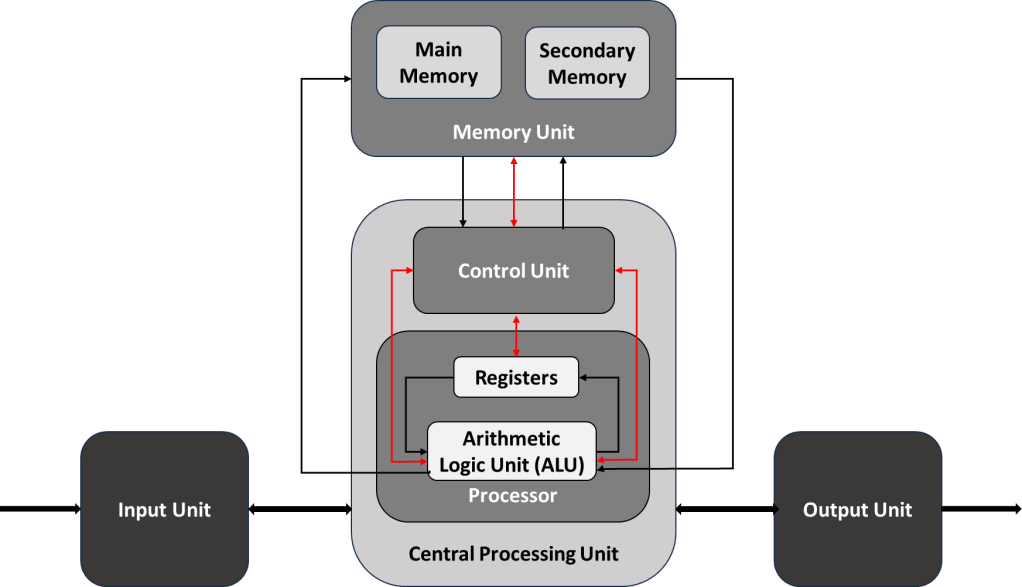
A computer is an electronic machine or a programmable device that can store, retrieve and process data.

Computer ArchitectureThe von Neumann Architecture

The CPU is the brain of the computer, consisting of:

Arithmetic Logic Unit (ALU): Performs arithmetic and logical operations.

Control Unit (CU): Directs the flow of data and instructions.

Registers: Small, high-speed storage for temporary data.

Example: In an Intel i7 processor, the ALU handles integer and floating-point calculations, while the CU manages instruction sequencing.

Memory stores data and instructions for processing. It is organized in a hierarchy:

Primary Memory: RAM (volatile) and cache (fast access).

Secondary Memory: Hard drives, SSDs (non-volatile).

Virtual Memory: Extends RAM using disk space.

Example: A system with 16GB RAM and 512GB SSD uses paging to manage virtual memory.

Handles communication between the CPU and external devices.

I/O Interfaces: Memory-mapped or isolated I/O.

Interrupts & DMA: Efficient data transfer without CPU intervention.

Example: A keyboard sends interrupts to the CPU, while a disk uses DMA for bulk data transfer.

Buses are communication pathways for data, addresses, and control signals.

Data Bus: Transfers actual data.

Address Bus: Specifies memory locations.

Control Bus: Manages read/write operations.

Example: PCIe bus connects GPUs to the CPU for high-speed data exchange.

Improves performance by overlapping instruction execution stages.

Instruction Level Parallelism (ILP) and Branch Prediction reduce delays.

Example: Modern CPUs like ARM Cortex-A use 5-stage pipelines to execute multiple instructions simultaneously.

Defines the CPU’s commands, addressing modes, and data formats.

Reduced Instruction Set Computer (RISC): Simple, fast instructions (e.g., ARM).

Complex Instruction Set Computer (CISC): Complex instructions (e.g., x86).

Example: ARM ISA powers most smartphones for energy efficiency.

Categories
Technology

Kubernetes Fundamentals

Kubernetes Architecture

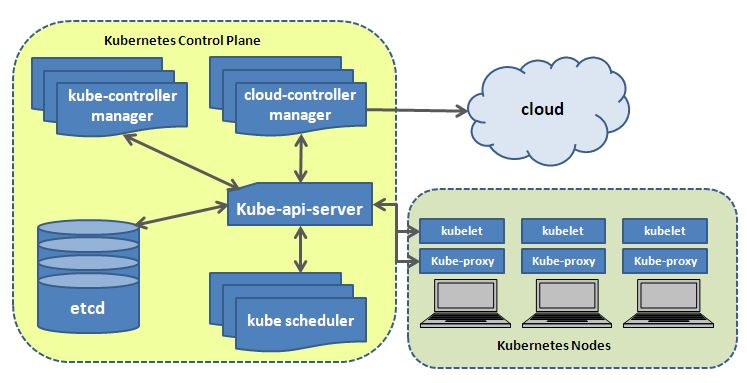
Kubernetes Server Node Types Making up Cluster

  1. Control Plane Nodes
  2. Worker Nodes

Control Plane Nodes

These are the brains of the operation. Control plane nodes contain various components which manage the cluster and control various tasks like deployment, scheduling and self-healing of containerized workloads.

kube-apiserver

This is the centerpiece of Kubernetes. All other components interact with the api-server and this is where users would access the cluster.

etcd

A database which holds the state of the cluster. etcd is a standalone project and not an official part of Kubernetes.

kube-scheduler

When a new workload should be scheduled, the kube-scheduler chooses a worker node that could fit, based on different properties like CPU and memory.

kube-controller-manager

Contains different non-terminating control loops that manage the state of the cluster. For example, one of these control loops can make sure that a desired number of your application is available all the time.

cloud-controller-manager (optional)

Can be used to interact with the API of cloud providers, to create external resources like load balancers, storage or security groups.

Worker Nodes

The worker nodes are where applications run in your cluster. This is the only job of worker nodes and they don’t have any further logic implemented. Their behavior, like if they should start a container, is completely controlled by the control plane node.

container runtime

The container runtime is responsible for running the containers on the worker node. For a long time, Docker was the most popular choice, but is now replaced in favor of other runtimes like containerd.

kubelet

A small agent that runs on every worker node in the cluster. The kubelet talks to the api-server and the container runtime to handle the final stage of starting containers.

kube-proxy

A network proxy that handles inside and outside communication of your cluster. Instead of managing traffic flow on its own, the kube-proxy tries to rely on the networking capabilities of the underlying operating system if possible.

Namespaces

A Kubernetes namespace can be used to divide a cluster into multiple virtual clusters, which can be used for multi-tenancy when multiple teams share a cluster.

Note: Kubernetes namespaces are not suitable for strong isolation and should more be viewed like a directory on a computer where you can organize objects and manage which user has access to which folder.

Categories
Computer Science Discovery Innovation Invention Learning Science Science and Technology Technology

Hello Everyone! Welcome to StellarRimz, the Science and Tech Hub

Welcome all to the new era of Science and Technology. There have been a lot of advancements in Science and Technology till now. So, we are here to get updated with all latest technologies and innovations. It’s going to be an interesting journey with you all!

Science and technology

Learning Sciences (LS) is an interdisciplinary field that works to further scientific, humanistic and critical theoretical understanding of learning as well as get involved in the design and implementation of innovations, and the improvement of instructional methods. Research in the learning sciences basically focuses on cognitive-psychological, social-psychological, cultural-psychological and critical theoretical foundations of human learning, as well as on designing of learning environments. Major contributing fields include cognitive science,  educational psychology,  computer science, applied linguistics and anthropology . Over the past decade, researchers have also expanded their concentrate to the design of curricula, informal learning environments, instructional methods, and policy innovations.

Why to Learn Science and get in touch with latest technologies?

Science and technology are closely related with our lives. They are closely linked aspects of society and the studies and developments in both these fields are very essential for the overall progress of mankind and humanity.

Scientific research mainly comprises of a wide variety of fields ranging from the study of different branches of science to relatively advanced fields like space exploration, Artificial Intelligence, Machine Learning, human genetics, and cloning. Scientific study attempts to explore and understand and innovate the working of the physical world. It tries to analyze and the occurrences in nature and gain knowledge about nature through experimentation. As scientific research targets at acquiring knowledge of the complexities in nature and finding solutions to unsolved problems, it is important for the progress of mankind. The seemingly impossible feats have been made possible, pay credit to scientific research and innovations in Technology.

Science and Technology

Types of Science studies:

  1. Natural Sciences.
  2. Artificial Sciences.

Natural sciences are concerned with the study of nature and human life. The Artificial Sciences deal with developing and inventing the new devices, scientific products, medicines, artificial technologies machines and infrastructure. The studies of natural and artificial sciences reveal the relationships between nature and human life. Research in science has paved a path to many brilliant inventions and discoveries.

The importance of technology resides in its manifold benefits to society. There are many positive effects of technology . The advancement in this area has revolutionized human life. It has provided an impetus to the computer and the telecommunication industry. The developments in communication technology have made the world a smaller place connecting every corner of the world. The Internet serving as an excellent communication platform has made the world flat and an easier to live place.

The World Wide Web has proved to be an enormous information network foundation, from which information can be retrieved by the means of search engines. Information from all around the world is clubbed and hosted on the web. Pay credits to development of web technology, the information can be stored in an organized manner and relevant information can be retrieved on supplying search strings to web search engines.

Digitization of information has been a major breakthrough in the world of information technology. It has made possible the compact storing of information, which in turn allows efficient information storage.

The most important benefit of science has been the luxury it has brought to daily life. The automation and machine advancement of industrial processes has reduced human efforts. Household appliances and and innovative products that are in daily use of the common man are a result of developments in science. Machines can do monotonous and risk-bearing tasks and hence protecting man from monotonous as well as dangerous but yet important tasks . Scientific discoveries have made human life easy and luxurious.

Without Science and Technology human life is almost unstable and meaningless.

Hope you enjoy the post! please drop your comments in below comments section. πŸ™‚ Thank you for reading!