
Artificial Intelligence (AI) is a trending technology around the world. Let’s understand its types.
What is AI?
Artificial Intelligence (AI) is the capability of a computational system to pursue human intelligence, like learning, reasoning, perception, problem solving, and decision making.
Types of AI
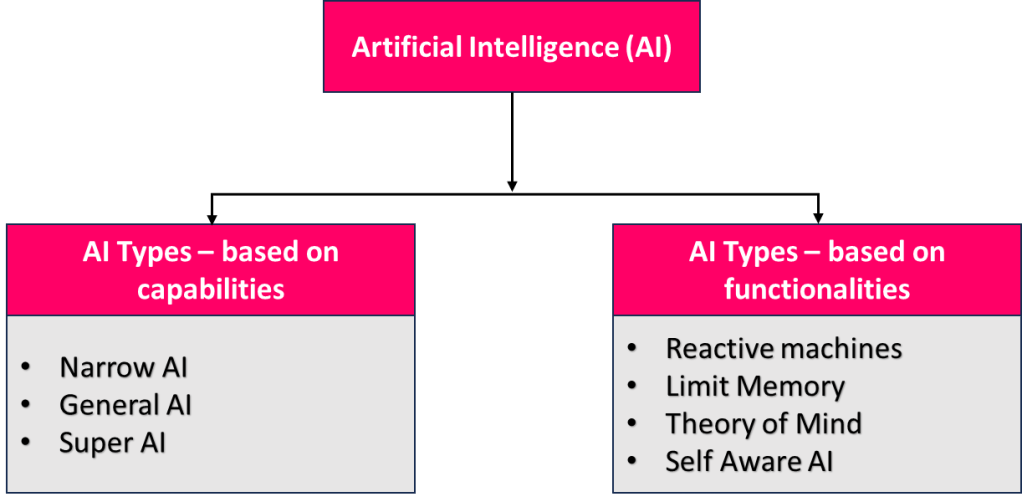
Types of AI based on capabilities:
Narrow AI (Weak AI): Narrow AI is designed and trained on a specific task or a narrow range of tasks. They perform their designated tasks but cannot generalize tasks. For example, Voice Assistants (Alexa, Siri), Face Recognition Systems, Recommendation systems like Netflix, etc.
General AI (General AI): General AI refers to machines that can perform any intellectual task like humans, with the ability to learn and adapt across tasks, though it remains theoretical and still not fully developed. For example, Autonomous Robots, AI diagnostics, Autonomous driving, cooking, and Coding.
Super AI (Super Intelligent AI): Super AI is a theoretical concept where AI surpasses human intelligence. They can make decisions of their own and solve problems on their own. For example, outperforms humans in all fields, including creative and Decision-making AI, raises ethical concerns, and controls.
Types of AI Based on Functionalities:
This classification is based on how AI handles data, memory, and decision-making in different scenarios.
1. Reactive Machines
Reactive machines purely operate based on the present data and do not store any previous experiences or learn from past actions. These systems respond to specific inputs with fixed outputs and are unable to adapt. Examples: AI Chess Bots, Pattern Recognition AI.
2. Limited Memory in AI
Limited Memory AI practices past data to make better decisions and predictions, but lacks long-term memory, and most modern AI applications belong to this type. Examples: Self-driving cars, Chatbots.
3. Theory of Mind
Theory of Mind AI tries to understand human emotions, beliefs, and intentions, enabling more sophisticated and responsive interactions. Examples: Human-Robot interface detecting emotions, Collaborative Robots in Healthcare.
4. Self-Awareness AI
Self-Aware AI is an advanced AI that holds consciousness, enabling it to understand emotions and have self-awareness like humans. Examples: Fully autonomous moral decision-making systems, environment-sensing robots.
Modern Real-World AI Systems
This classification is generally based on what the AI can do in real-world systems.
1. Generative AI (Gen AI)
Gen AI creates new content like text, images, audio, or code by learning patterns from data. It uses deep learning models like transformers. Example: Chatbots generating answers, AI image generators, and code generation tools.
2. Agentic AI
Agentic AI acts autonomously to achieve goals, making choices and executing tasks without constant human input. It can plan, execute, and adapt. Example: AI that books tickets after comparing prices, Task automation agents, and multi-step problem-solving systems.
3. Natural Language Processing (NLP)
NLP allows machines to understand, interpret, and communicate using human language. Works with text and speech. Example: Chatbots, Language translation, Sentiment analysis.
4. Computer Vision
Computer Vision allows machines to analyse, recognize, and interpret images and videos. It detects objects, faces, and patterns from visuals. Example: Face recognition, medical image analysis, and self-driving car vision systems.

 StellarRimz