
The Basics – You Must Know
What is a computer?
A computer is an electronic machine or a programmable device that can store, retrieve and process data.
Computer Architecture
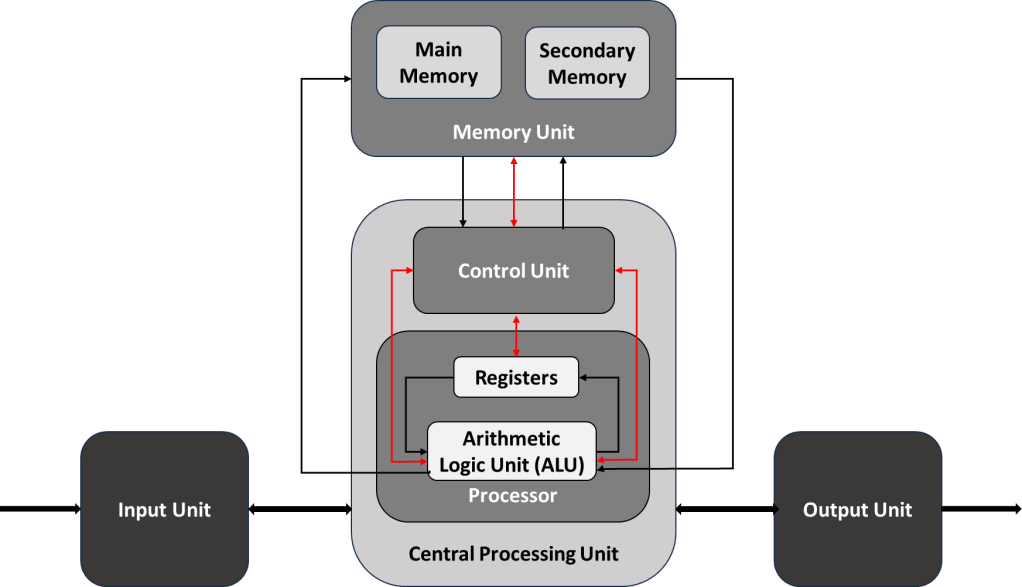
Computer Architecture – The von Neumann Architecture
The Components of Architecture
- Central Processing Unit (CPU):
The CPU is the brain of the computer, consisting of:
Arithmetic Logic Unit (ALU): Performs arithmetic and logical operations.
Control Unit (CU): Directs the flow of data and instructions.
Registers: Small, high-speed storage for temporary data.
Example: In an Intel i7 processor, the ALU handles integer and floating-point calculations, while the CU manages instruction sequencing.
- Memory Organization:
Memory stores data and instructions for processing. It is organized in a hierarchy:
Primary Memory: RAM (volatile) and cache (fast access).
Secondary Memory: Hard drives, SSDs (non-volatile).
Virtual Memory: Extends RAM using disk space.
Example: A system with 16GB RAM and 512GB SSD uses paging to manage virtual memory.
- Input/Output (I/O) Organization:
Handles communication between the CPU and external devices.
I/O Interfaces: Memory-mapped or isolated I/O.
Interrupts & DMA: Efficient data transfer without CPU intervention.
Example: A keyboard sends interrupts to the CPU, while a disk uses DMA for bulk data transfer.
- Bus Systems:
Buses are communication pathways for data, addresses, and control signals.
Data Bus: Transfers actual data.
Address Bus: Specifies memory locations.
Control Bus: Manages read/write operations.
Example: PCIe bus connects GPUs to the CPU for high-speed data exchange.
- Pipelining & Parallelism:
Improves performance by overlapping instruction execution stages.
Instruction Level Parallelism (ILP) and Branch Prediction reduce delays.
Example: Modern CPUs like ARM Cortex-A use 5-stage pipelines to execute multiple instructions simultaneously.
- Instruction Set Architecture (ISA):
Defines the CPU’s commands, addressing modes, and data formats.
Reduced Instruction Set Computer (RISC): Simple, fast instructions (e.g., ARM).
Complex Instruction Set Computer (CISC): Complex instructions (e.g., x86).
Example: ARM ISA powers most smartphones for energy efficiency.
 StellarRimz